Dear Friend —
In 1969, South Seattle Community College hardly existed yet: a founding president, classes in borrowed buildings, and a future campus one early colleague remembered as “the mud of a January.” It also had a new secretary in her mid-fifties. She would go on to teach in the college’s brand-new horticulture program and become a beloved, motherly presence among students.
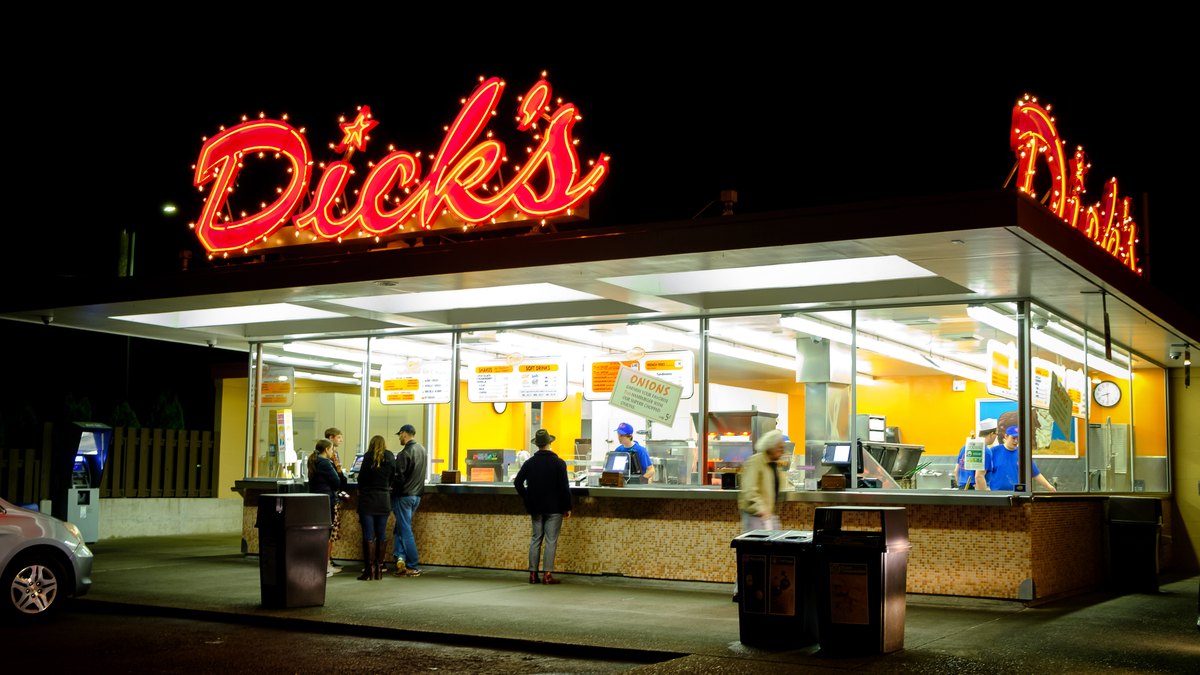
Her name was Bea Haverfield. While you’ve possibly never heard of her, you’ve almost certainly encountered her penmanship: it crowns every Dick’s Drive-In. Long before she came to South, Bea had designed many of the neon signs that cheer Seattle’s winter nights.
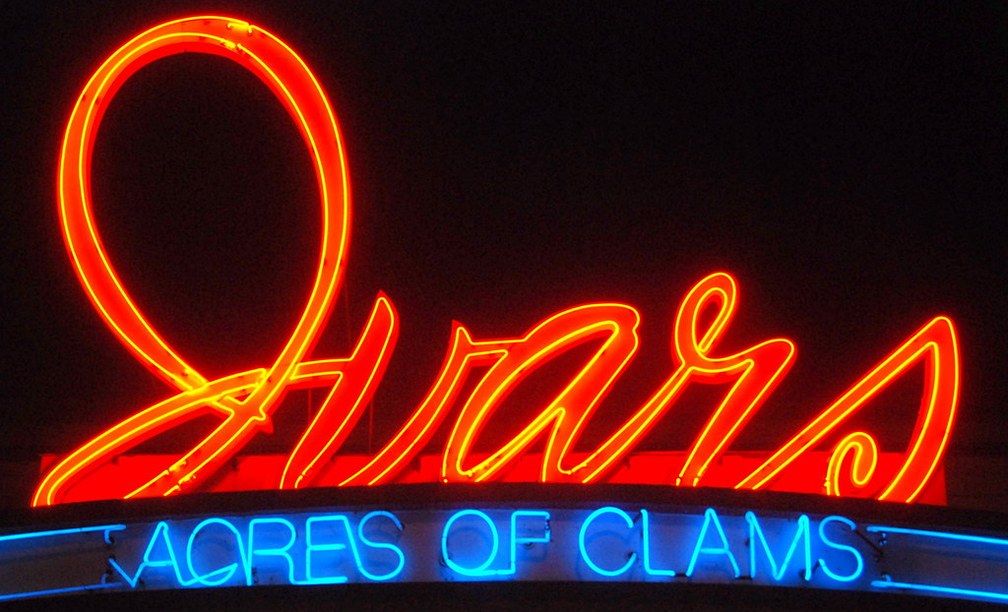
Above: Ivar’s Acres of Clams on Pier 54, one of her first commissions. Photo: Damon Tighe
BEFORE THE GARDEN, THE GLOW
Bea was born in Seattle in 1913 to Finnish immigrants. Her father worked at the Seattle Gas Light Company — the plant we now know as Gas Works Park. His daughter would build a career on gas too. She just preferred hers to glow.
She and her husband, Elden Filer, started a sign business: she designed, he built. During World War II she helped assemble airplanes at Boeing — her “Rosie the Riveter phase,” as historian Brad Holden puts it. Around 1946 the couple joined Campbell Neon, and Bea became one of its lead designers. Her portfolio reads like a tour of the city, past and sometimes present, after dark: Ivar’s, the Chubby & Tubby boomerang, Hat ’n’ Boots, Sunny Jim peanut butter, the Rainier “R,” Dick’s and Cinerama.
Then, in 1956, came Bea’s best-known design: the Elephant Super Car Wash signs at Battery and Denny, with four little elephants at the base, two blue, two pink, one for each of her children. Seattle’s postwar skyline wasn’t just being brightened. It was being lit with wit.
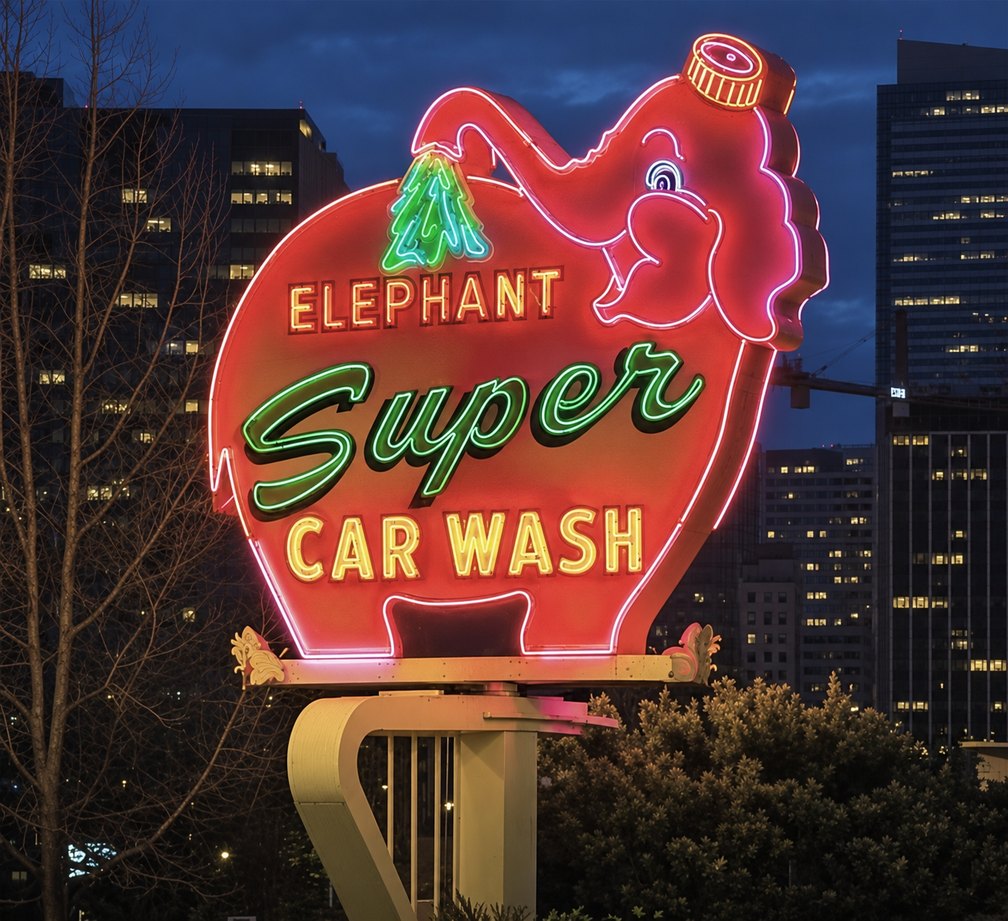
Above: One of Bea’s two pink elephants for the Elephant Super Car Wash at Battery and Denny. The smaller one now stands at Seventh and Blanchard. The larger, 22 feet tall, has been restored for the Museum of History & Industry (MOHAI), which is still looking for a space big enough to show it. Photo: M. Beneke
CHRONICLING THE CITY’S NEON
We owe much of what we know about Seattle’s neon to two enthusiasts. Brad Holden rescued Bea’s story in a 2020 Seattle Times profile, working from sketches her family had kept. Photographer Matt Hucke walked every Seattle neighborhood, by day and by night, to make Seattle Neon: Signs of the Emerald City, a tour of more than 450 signs, including many of Bea’s.
“Neon is a statement that a business expects to survive long enough to be worth the effort,” Hucke writes.
BUSY BEA: SOME OF HAVERFIELD’S WORK
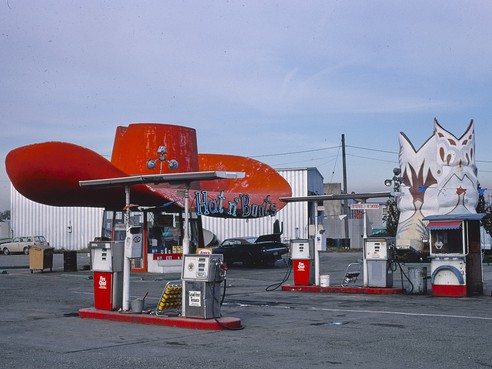 Hat ’n’ Boots, Georgetown, in the 1970s, on land now part of South’s Georgetown Campus. Photo: Flashbak.com |
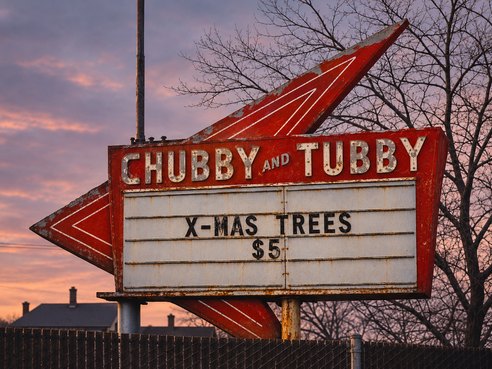 Chubby & Tubby, the Rainier Avenue South surplus store. Bea designed the boomerang. Photo: M. Beneke |
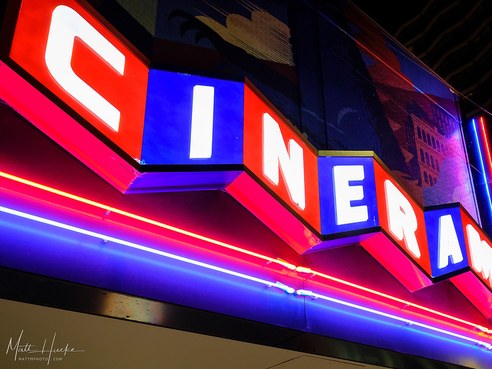 Cinerama, Fourth Avenue. Bea helped design its first sign. Photo: Matt Hucke |
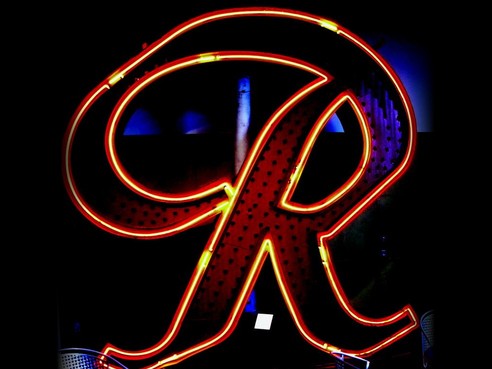 Rainier “R,” the 1950s original, aglow at MOHAI in 2009. Photo: robthebusinesswriter |
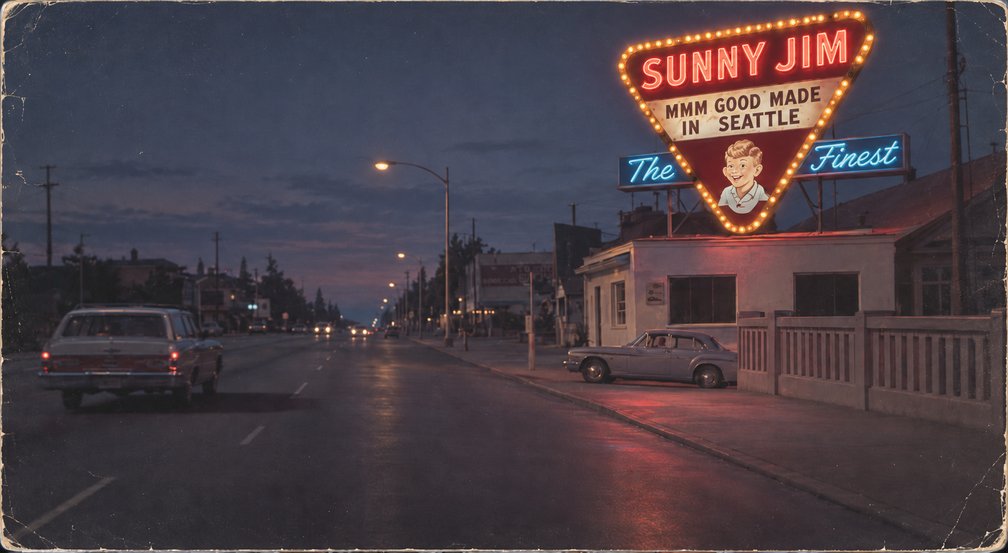 Sunny Jim peanut butter, a long-gone Highway 99 landmark. Photo: Gerald Nielsen / Seattle Vintage 1.0. AI color-enhanced.
AFTER THE GLOW, THE GARDEN
Bea’s hands were damaged in a late-1960s car accident, tragically ending her design career. And then, in 1968, she lost her husband, Robert. She could have stopped there. Instead, she went to work at the new college in West Seattle.
South gave her a second act. In addition to teaching in the school’s new horticulture program, she embraced the idealism of the time, marching for civil rights and against the Vietnam War. She even offered her own house as collateral to bail out the Seattle Seven, antiwar activists charged with conspiracy after a 1970 protest at Seattle’s federal courthouse.
Bea died in 1996. Students in the horticulture program where she taught later went on to create the South Seattle College Arboretum. And her signs still glow across the city.
Any way you look at it, hers was a life that shone.
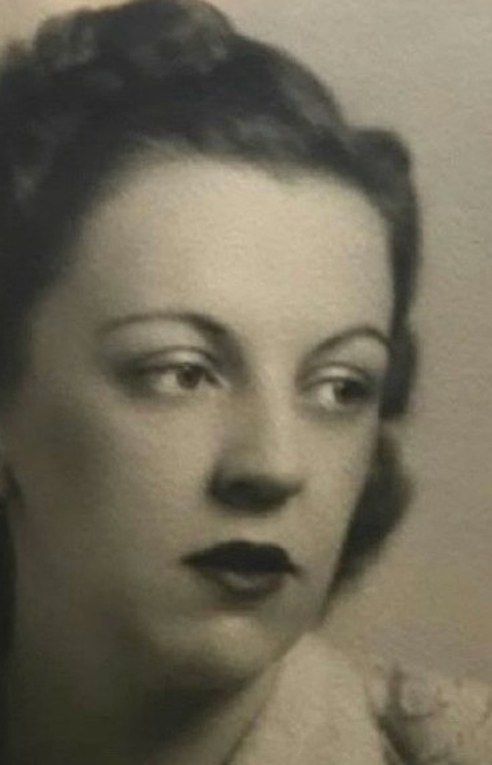
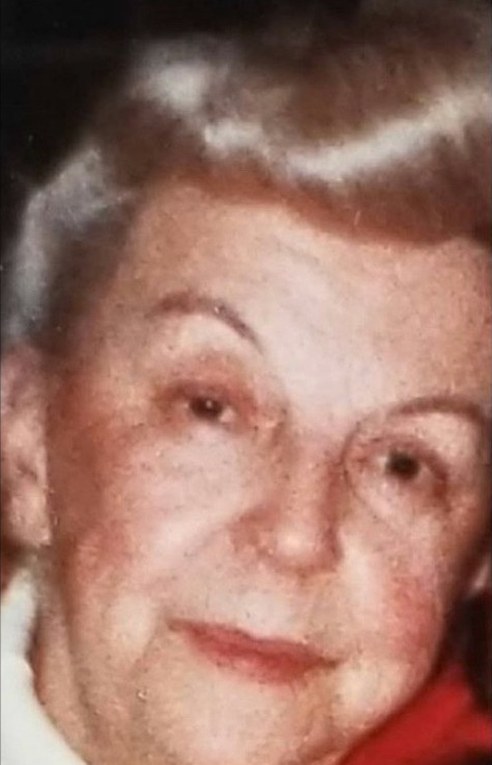
Above: Bea Haverfield as a young woman, about 1935, and later in life. Photos: Seattle Refined
KEEP EXPLORING
READ MORE ABOUT BEA AND SEATTLE NEON
Questions, comments, or feedback about this issue of The College Minute? We’d love to hear from you. Send us a note at minute@seattlecolleges.edu.
The College Minute is produced by the Seattle Colleges Foundation. To meet the challenges ahead, our community needs the talents of everyone, of every background. We help students at the Colleges — particularly students historically underserved by higher education — to dream big, be supported, and fully realize their unbounded potential. Learn more here.
|
|